Inrush current on the construction site: Which tools need up to 18 kW starting power
Many professional devices draw a multiple of their rated power at the moment of switching on. Those working off-grid don't fail because of continuous power – but because of the inrush peak. Here you can read which tools are affected and why 18 kW of peak power makes the difference.
What is inrush current (starting current)?
Electric motors, compressors and pumps briefly require significantly more power at startup than during continuous operation. This inrush current (also called starting or inrush peak) arises because the motor accelerates from standstill and builds up the magnetic field. Depending on the motor type, the peak can reach 3 to 7 times the rated power – but only for fractions of a second.
For an off-grid power source, this means: it is not the continuous power in watts that determines whether a device starts, but whether the source can deliver the short inrush peak without the voltage collapsing. This is exactly where many small power stations fail.
Technical background: current, voltage & power at startup
During direct-on-line starting (Direct-on-Line, DOL) of an asynchronous motor, the starting or locked-rotor current ILR flows. According to IEC 60034-12 and NEMA MG-1, it is typically 5 to 8 times the rated current IN (Full-Load Ampere, FLA); the locked-rotor apparent power can reach roughly 10 times the rated power.
Decisive is the low power factor (cos φ ≈ 0.2–0.4) at the moment of startup: the motor draws predominantly reactive power, so the apparent power S (kVA) is significantly higher than the later active power P (kW). A source must therefore be able to deliver the kVA peak – not just the continuous watt power.
If this high current flows through the internal impedance Z of the source, a voltage dip is created: ΔU = ILR · Z. IEEE Std 399 (Brown Book) gives a guideline of max. 15 % dip at the motor terminals (≈ 5 % at the busbar). If the dip is larger, the motor stalls, undervoltage protection trips and contactors drop out.
With an inverter source (power station / battery power generator), the peak is doubly limited: by the maximum peak current of the inverter and by the hold duration. Only if both are sufficient is the locked-rotor phase (typically 0.2–0.5 s) bridged. In addition, transformers draw a magnetizing inrush of up to 8–12× for a few line cycles.
The GM 3600 addresses this with a high peak reserve (up to 18 kW ≙ measured 18,462 W at 229 A / 228 V), sufficient hold duration (≈ 1 s) and pure sine wave at low internal impedance – so the voltage dip stays small and the motor starts up.
Which devices have high inrush peaks?
The following overview shows typical professional loads and their approximate inrush demand. The values are guideline figures – the actual peak depends on the model, motor type (asynchronous/universal) and load.
| Device / load | Typical continuous power | Inrush factor | Rough inrush peak |
|---|---|---|---|
| Inverter welding machine | 3–5 kW (duty cycle) | high, short load peaks | up to > 10 kW |
| Construction/refrigeration compressor | 2–3 kW | 3–5× | 6–15 kW |
| Submersible/dirty water pump (asynchronous) | 1–2.2 kW | 5–7× | up to ~15 kW |
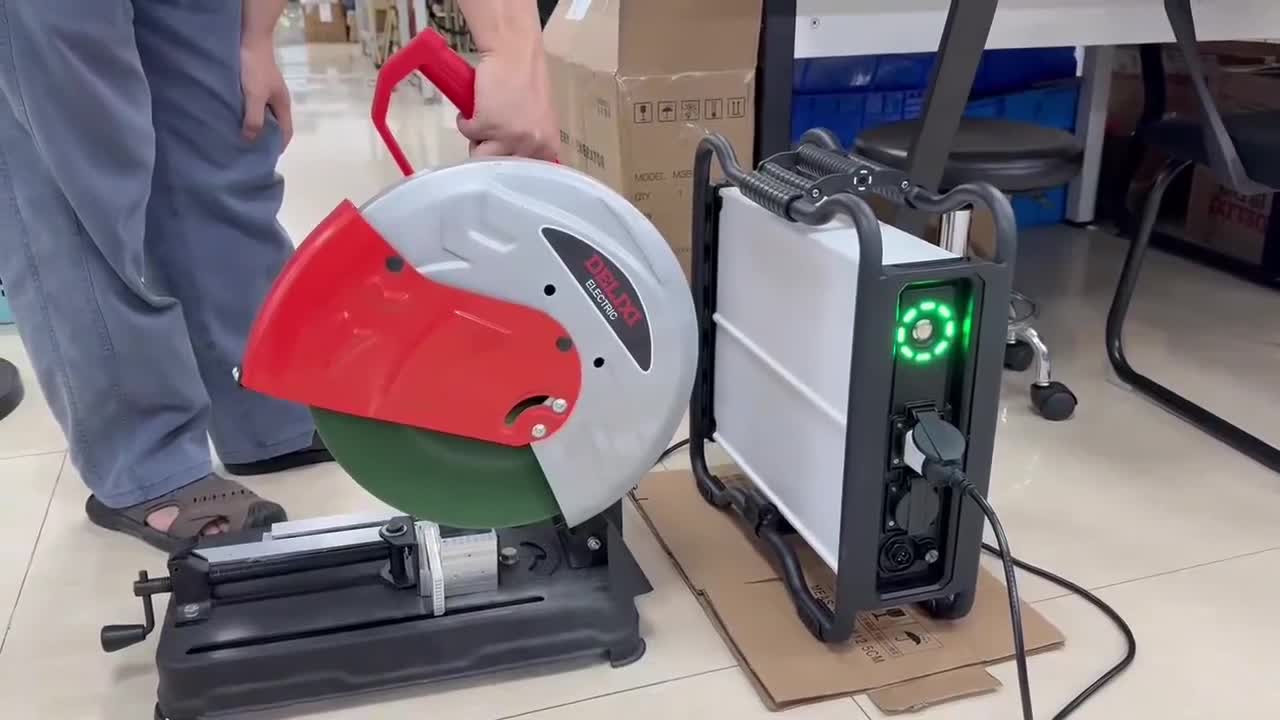
| Cut-off grinder / circular saw / chop saw | 2–3 kW | 2–4× | 6–12 kW |
| Core/diamond drill | 2–3.5 kW | 2–3× | 6–10 kW |
| Mortar/screed mixer, plastering machine | 1.8–2.5 kW | 3–5× | 6–12 kW |
| High-pressure cleaner (motor) | 2–3 kW | 3–4× | 6–12 kW |
In practice, several factors add up: a high-inrush motor plus already running consumers on the same device. That is why a generous peak reserve is not a luxury but the prerequisite for the tool to start at all.
Why 18 kW of peak power makes the difference
A typical 3.6 kW power station with only double the peak (≈ 7.2 kW) quickly reaches its limits with high-inrush asynchronous motors or compressors – the device does not start or shuts down. The GM 3600, by contrast, delivers:
- 3,600 W continuous power (pure sine wave)
- 7,200 W sustainable continuously at 200% overload
- up to 18,000 W peak (500%) – measured by oscilloscope at 18,462 W (229 A at 228 V), held for ~1 s
This reserve reliably starts even motors and compressors with high inrush current. The pure sine wave is decisive for inductive loads (motors, transformers, inverter welding machines) – a "modified" sine wave can damage such devices or prevent them from starting at all.
Why normal power stations "drop out" at startup
The decisive point is rarely prominent in the data sheet: how long can a device hold its peak? Many consumer power stations advertise a high "surge" value – but only hold it for 5 to 10 milliseconds. A motor, however, needs 200 to 500 milliseconds to get from standstill up to speed. If the inverter drops out of peak mode before that, the voltage collapses and the device shuts down for self-protection (overload) – it "chokes" on the inrush current.
This is exactly what happens in practice with submersible pumps, compressors or inverter welding machines on ordinary power stations. The following graphic shows the principle:
Schematic representation. The inrush peak (black) lies above the shutdown threshold of ordinary power stations (red) – these disconnect. The GM 3600 holds the reserve up to 18 kW (green) long enough for the motor to start up.
Normal power station vs. GM 3600 – the difference
| Criterion | Typical consumer power station | GM 3600 |
|---|---|---|
| Continuous power | ~0.3–2.4 kW | 3.6 kW (7.2 kW at 200%) |
| Peak | mostly 1.5–2× rated power | up to 18 kW (500%) |
| Peak held | often only milliseconds | ≈ 1 s (measured) |
| Sine wave | partly modified | pure sine wave |
| Protection rating | mostly none (indoor/camping) | IP54 (dust/splash water) |
| Design | Camping, backup power, leisure | Construction site, professional, continuous load |
Consumer devices (camping/backup power) are simply not designed for high-inrush professional loads – too little continuous power, too short a peak, often no pure sine wave and no outdoor protection. The GM 3600 is built for exactly this as an industrial storage unit.
Before battery power generators: the pain points on the construction site
Before mobile 230 V battery power generators (Instagrid & co.) shaped the market, there were only two off-grid options – both with clear disadvantages:
- Petrol/diesel generator: loud (typically 75–100 dB – hearing strain, stress, trouble with neighbours), exhaust fumes (CO, particulate matter, nitrogen oxides) – prohibited indoors, in underground car parks and in low-emission zones, plus fuel logistics, maintenance and idling consumption.
- Long extension cables from the nearest mains connection: tripping hazards, voltage drop over long distances, and often simply no connection within reach.
Mobile battery power generators solved this: emission-free, quiet, ready to use immediately – the clean power socket right where you need it. The GM 3600 continues this approach and adds the high inrush reserve up to 18 kW, which makes high-inrush professional tools possible in the first place – at a significantly lower price than the established brand-name devices.
Which construction sites & special applications need this
A high inrush reserve plus emission-free operation is required wherever a diesel generator is too loud, too dirty or prohibited – and heavy tools still have to run:
- Emission-free indoor, night and weekend construction sites: renovation, tunnels, underground car parks, interior finishing – no exhaust fumes, quiet, yet full tool performance.
- Low-emission zones & inner-city construction sites: where combustion engines are not permitted.
- Landscaping & hydraulic engineering: submersible and dirty water pumps with high inrush current, far from any mains connection.
- Mobile service & assembly jobs: one device in the service vehicle for saw, drill, compressor and welding machine.
- Film, event & trade fair: quiet, off-grid 230 V supply – also for high-inrush equipment.
- Backup power for pumps & equipment: when a lot of power is needed briefly at startup.
Off-grid, emission-free construction power supply – from €2,999 net.
To the GM 3600 & comparison →Frequently asked questions
Why does a tool need more power at startup than during operation?
At the moment of switching on, motors and compressors draw an inrush current that, depending on the motor type, can be 3 to 7 times the rated power – for fractions of a second. The power source must deliver this peak, otherwise the voltage collapses.
What peak power does the GM 3600 deliver?
3,600 W continuous, 7,200 W at 200% overload and up to 18,000 W peak (500%, measured 18,462 W). This starts even high-inrush motors, compressors and cut-off saws.
Is a normal 3.6 kW power station enough for a welding machine or submersible pump?
Often not – devices with only a 2x peak (~7.2 kW) collapse under high-inrush loads. High peak power and a pure sine wave are important; the GM 3600 covers significantly larger inrush peaks with up to 18 kW.
Read more: GM 3600 vs. Instagrid ONE · Mobile power supply construction site · Power station for welding machines
Sources & standards
- IEC 60034-12 – Rotating electrical machines, Part 12: Starting performance of single-speed three-phase cage induction motors (starting behaviour, locked-rotor apparent power).
- NEMA MG-1 – Motors and Generators (Code Letters, locked-rotor kVA per HP).
- IEEE Std 399 (Brown Book) – Recommended Practice for Industrial and Commercial Power Systems Analysis (motor starting / voltage dip study, guideline 15 % at motor terminals).
- NEC Article 430.52 – Motor branch-circuit protection (inrush current design).
Note: Inrush factors and standard values are guideline figures and serve for orientation. The specifications of the respective device manufacturer as well as the relevant standards in their current version are authoritative.